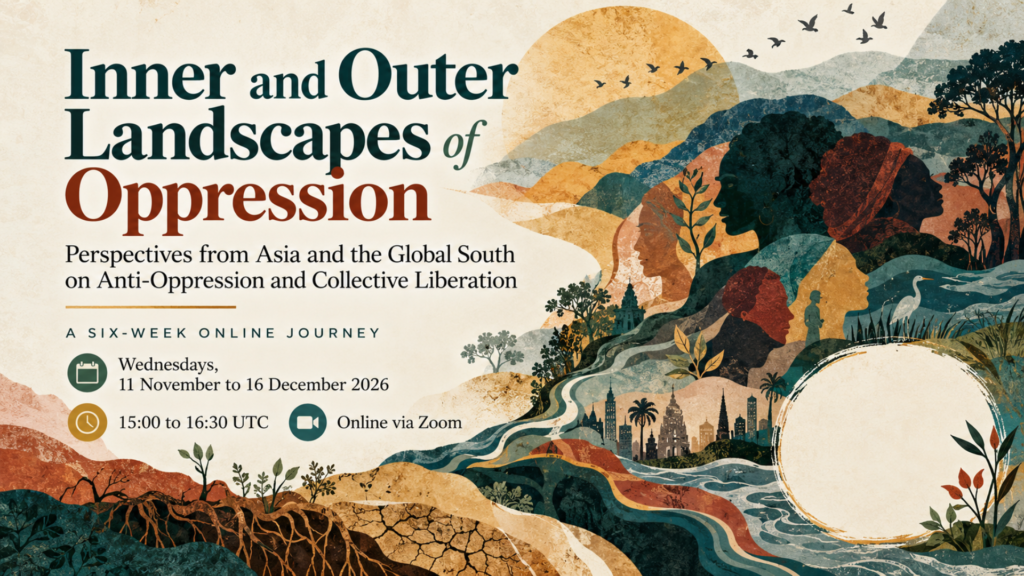
Inner and Outer Landscapes of Oppression
Perspectives from Asia and the Global South on Anti-Oppression and Collective Liberation
A six-week online journey
Wednesdays, 11 November to 16 December 2026
15:00 to 16:30 UTC | Online via Zoom
About the Journey
Systems of oppression do not exist only in institutions, laws or visible inequalities. They also shape how we understand ourselves and one another: whose knowledge we trust, whose voices we hear, what bodies and identities we consider legitimate, how we relate to power, and what we have learnt to see, or not see. They live outside us, between us and within us.
Inner and Outer Landscapes of Oppression is a six-week experiential journey into these interconnected landscapes. Drawing on the Work That Reconnects, anti-oppression and decolonial thought, systems thinking, embodied inquiry and critical pedagogy, we will explore how systems of hierarchy become normalised and reproduced, and how we might participate in their transformation.
Much contemporary anti-oppression discourse available internationally has been shaped by the particular histories and categories of North America and Europe. While these contributions are valuable, they do not encompass the many ways oppression is organised and experienced elsewhere. This journey deliberately centres Asian and Global South histories and realities, while remaining in conversation with struggles and scholarship from around the world.
We will encounter caste and social stratification; religion, nationalism and belonging; class, labour and migration; gender, sexuality, disability and the body; coloniality and ecological harm. We will explore how these intersect and become embedded in relationships, institutions, cultures and ways of knowing.
And we will repeatedly turn the inquiry towards ourselves: What systems have shaped me? Where do I experience marginalisation, privilege or both? What have I learnt to normalise? What happens in my body when power, difference or conflict enters the room? Whose knowledge do I instinctively recognise as authoritative? Where might I reproduce patterns I consciously oppose?
The Journey
Across six sessions, we will move through an arc of inquiry:
Locating ourselves within systems of power and beginning to notice how outer structures acquire inner lives.
Session 2 – Caste and Stratification: Beyond the Literal
Exploring caste as a particular historical system and as a lens through which to examine how societies construct hierarchy, purity, belonging and human worth.
Session 3 – Religion, Nation and Belonging
Examining identity, othering and the boundaries through which communities construct belonging and exclusion.
Session 4 – Class, Labour, Migration and Dignity
Following the often-invisible relationships that sustain our lives and asking how economic systems distribute labour, mobility, resources, recognition and dignity.
Session 5 – Gender, Sexuality, Disability and the Body
Exploring how power becomes inscribed upon bodies, identities and norms, and how bodies can also become sites of knowing, resistance and liberation.
Session 6 – From Interlocking Oppression to Collective Liberation
Bringing the strands together through systems thinking and the Work That Reconnects, moving from awareness towards responsibility, solidarity, praxis and possibilities for change.
The journey is deliberately participatory, not diagnostic. We will resist reducing ourselves or one another to fixed categories of “oppressor” and “oppressed”. Power is historically and structurally unequal, while our locations within systems of power can be complex, intersectional and context-dependent.
How We Will Work
The sessions will weave together:
- Embodied and reflective inquiry to notice how systems live in our assumptions, emotions, nervous systems and everyday choices.
- Collective dialogue in which different experiences and interpretations can encounter one another without requiring premature agreement.
- Conceptual inputs drawing from anti-oppression, decolonial, feminist, caste, systems and liberation traditions.
- Work That Reconnects practices, including the Expanded Spiral, connecting personal, social and ecological transformation.
- Creative and systems practices including mapping, journalling, drawing and narrative inquiry.
- Between-session reflection through selected readings, videos and worksheets.
The intention is neither ideological certainty nor a checklist for becoming “anti-oppressive”. We will cultivate our capacity to notice power, remain present to complexity, recognise our participation in systems and enlarge our capacity to act differently.
The learning space itself will also become part of the inquiry. Whose knowledge counts? Who holds authority? Whose voices are easily heard and whose require greater attention? What assumptions about language, time, accessibility, expertise and participation do we bring into the room? In this sense, decolonisation concerns not only what we explore, but how we learn together.
Who Is This For?
This journey may be particularly relevant for people engaged in peacebuilding, social and ecological justice, leadership, facilitation, education, organisational transformation, community work and systems change, as well as anyone seeking a deeper inquiry into their own relationship with power and oppression.
No prior academic knowledge of anti-oppression theory is required. Familiarity with the Work That Reconnects may be helpful, but is not necessary.
What matters is a willingness to approach difficult questions with curiosity, humility and responsibility, including the possibility of encountering aspects of ourselves and the systems we inhabit that may be uncomfortable.
Practical Details
Dates: Wednesdays, 11 November to 16 December 2026
Time: 15:00 to 16:30 UTC
Format: Six weekly 90-minute sessions via Zoom
Commitment: Participants are encouraged to attend all six sessions, as the inquiry develops progressively across the six weeks.
Between sessions: Participants will receive selected readings, videos and reflective material to deepen the inquiry between gatherings.
Recordings: Recordings (excluding breakout spaces and sensitive sharing) will be available for up to a month after the sessions, only to participants.
Contribution: Sliding scale USD 100 – 500. We encourage those with financial capacity to contribute at the higher end to enable scholarships for other participants. Participation is confirmed only after payment is received. If the lower end of the sliding scale is beyond what is possible for you, please write to rukmini@exult-solutions.com; we will do our best to make participation possible
Facilitator

Rukmini Iyer is a leadership and organisational transformation consultant, peacebuilder, dialogue facilitator and Work That Reconnects facilitator based in India. Her work sits at the intersections of conscious leadership, systems transformation, peacebuilding, ecocentrism and decolonial practice.
Born into a South Indian Brahmin family, she enters this journey conscious of the caste privilege and social protection afforded by her own location. Her work across cultures and geographies has also led her to examine how colonial histories continue to shape contemporary institutions, knowledge systems, relationships and ideas of development.
She approaches this series as a facilitator and fellow participant in the inquiry, rather than as someone standing outside the systems being examined.